How to Cut Meta Ad CAC by 80% Using Click-to-WhatsApp Ads and Conversions API
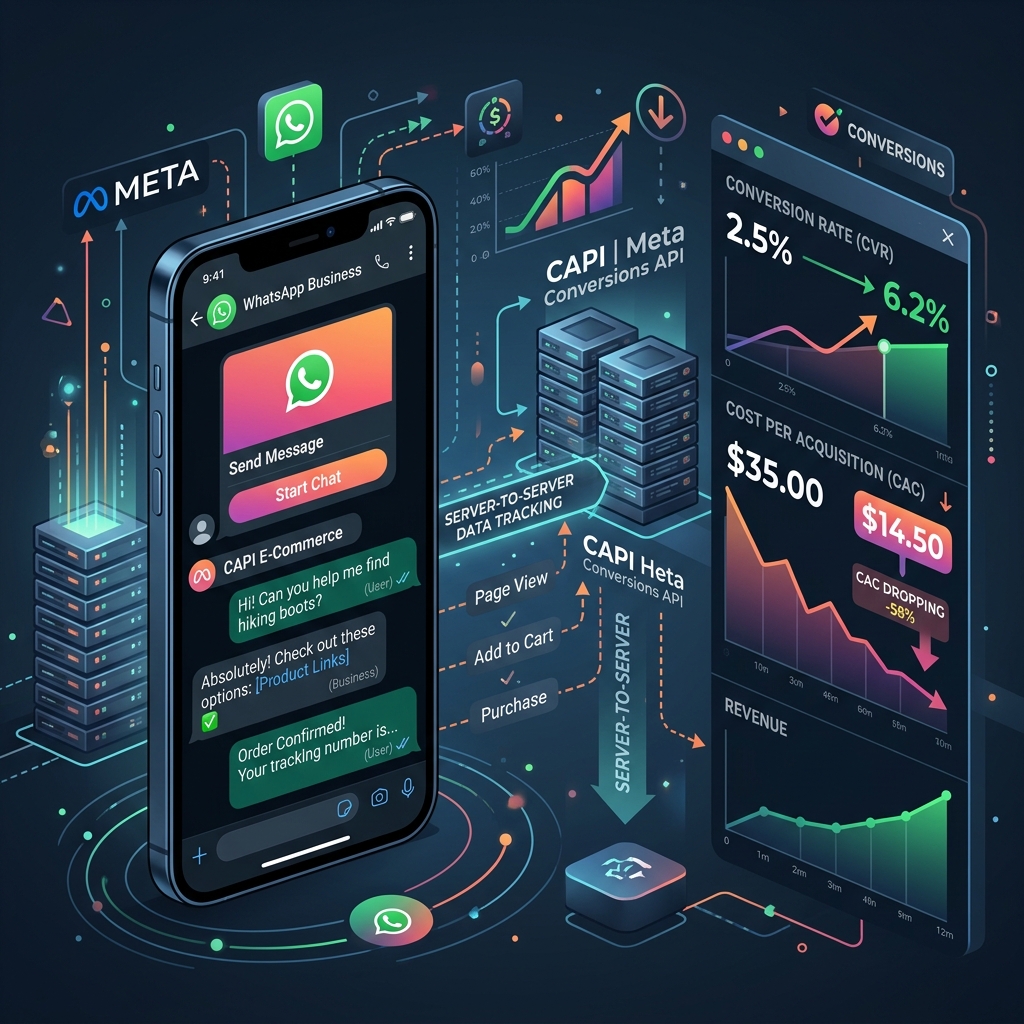
Most Meta advertisers are losing money in two places at once: overpaying for clicks, and then losing the conversion signal before it reaches the algorithm. Fix both, and your CAC collapses.
Here’s the structural reality: Click-to-WhatsApp (CTWA) ads run at 30–50% lower CPMs than standard website click or lead gen campaigns. Meta deliberately prices them cheaper because keeping users inside WhatsApp is worth more to their ecosystem than sending traffic off-platform. That’s an arbitrage opportunity most advertisers are leaving untouched.
But the CPM discount alone doesn’t win. Without conversion signal flowing back to Meta, the algorithm optimizes for what it can measure — “Conversations Started” — which means it finds people who tap and ghost. You get cheap clicks and expensive nothing.
The fix is pairing CTWA with Meta’s Conversions API (CAPI) and an AI qualification layer. Together, they close the loop: cheaper entry, higher-intent users, and a feedback signal that teaches Meta’s algorithm exactly who converts. Here’s how each piece works.
1. Stop Paying the Landing Page Tax
Every time a user has to leave the ad, click through to a mobile page, wait for it to load, and decide whether to fill out a form — you’re bleeding conversions. Industry benchmarks put mobile landing page bounce rates at 20–40%. That’s money evaporating before a single lead is generated.
CTWA eliminates this entirely. One tap opens a WhatsApp thread directly with your brand. No page load, no form abandonment, no redirect friction. The user is in conversation before they’ve had a chance to reconsider.
This is also why Meta’s auction favors these units. More time on-platform, more ad inventory, lower CPMs for you.
2. Qualify with AI - Not Forms
The failure mode of most WhatsApp campaigns is treating the chat like a form. Rigid, sequential questions kill the conversational feel and drive drop-off.
Instead, deploy a conversational AI agent that qualifies leads naturally — asking about budget, timeline, or use case as part of a back-and-forth exchange rather than a bureaucratic intake flow. The agent dynamically parses intent throughout the conversation: not waiting for a button click, but reading comprehension signals to determine when a user crosses your ICP threshold.
When they do, the backend fires a structured conversion event — LeadSubmitted, AppointmentBooked, Purchase — and prepares it for transmission to Meta. This is the moment that matters.
3. Send Conversion Signal Server-Side
Browser pixels are structurally unreliable. iOS ATT, Safari ITP, Chrome’s deprecation of third-party cookies, ad blockers — up to 30% of real conversions go dark before they reach Meta’s attribution model. When the algorithm is flying blind, it optimizes on noise.
CAPI bypasses the browser entirely. When the AI agent qualifies a lead, that conversion event travels directly from your backend to Meta’s servers — no client-side dependency, no ad blocker in the way.
The signal quality is also dramatically higher. Because CAPI sends hashed first-party identifiers — phone numbers, emails, WhatsApp IDs — and because WhatsApp accounts are tied to verified phone numbers, Meta can match the conversion back to the exact user who saw the ad with near-100% accuracy. That’s a fundamentally different quality of attribution than a browser cookie.
4. Deduplicate or Your Reporting Breaks
If users eventually click a payment link and complete a purchase on your website, you now have two events potentially firing for the same conversion: the CAPI event from the AI qualification, and a pixel event from the website. Meta will count both. Your ROAS will look great. Your optimization will be garbage.
The solution is deduplication. Every CTWA click carries a unique ctwa_clid parameter. Pair that with a unique message ID, and you give Meta the keys to deduplicate server-side events against pixel events. The algorithm sees one conversion milestone per user — clean, distinct, attributable. This is what lets machine learning actually work.
5. Feed the Signal Back and Let Advantage+ Relearn
Meta’s Advantage+ campaigns are only as good as the signal you give them. Optimize for “Conversations Started” and the algorithm finds people who tap and disappear. Stream LeadSubmitted and Purchase events via CAPI, and you’re telling the algorithm exactly what a high-value user looks like.
Within 48–72 hours, the model re-weights. It pulls budget away from click-and-bounce cohorts and redirects impressions toward users who match the conversion pattern it’s learned. This compounding effect — better signal → better targeting → lower CAC — is where the 80% reduction actually comes from. It’s not a one-time optimization. It’s the algorithm continuously getting smarter on your behalf.
The Compounding Effect
Each of these five steps is meaningful in isolation. Combined, they’re structural. Cheaper inventory, frictionless entry, AI qualification, clean server-side signal, and algorithmic feedback create a flywheel that conventional lead gen campaigns can’t match.
To connect your WhatsApp ads to Meta’s bidding engine, visit our Conversions API setup page — setup takes under 15 minutes.
The Peach Team
Expertise in WhatsApp Sales & AI