WhatsApp Calling for Inside Sales: Why Your Reps Should Never Switch to the Phone Again
Your reps spend 40 minutes a day switching between WhatsApp and their phone.
The gap is costing you more than you think
Not selling. Switching.
A lead comes in on WhatsApp. The agent qualifies them in chat, builds rapport, gets to budget and intent — and then picks up a different device to make the actual call. Then comes back to WhatsApp to send the follow-up. Then opens the CRM to log what happened. Then tries to remember what was said.
That is four context switches per lead. Multiply by 50 leads a day, 40 agents, and you start to see the actual cost — not in time, but in what falls through the gaps every single time.
Your manager has no record of what happened on that call. Was it a 2-minute rejection? A 20-minute negotiation where the customer asked about pricing three different ways? A Promise to Pay that needs a follow-up in 48 hours?
The CRM entry says “called.” Full stop.
What actually happened is locked inside a personal device, in a call log no one will ever see, connected to a number that belongs to the agent — not the business. When that agent leaves next month, so does every conversation they ever had with a customer.
47% of enterprise WhatsApp teams have lost lead data this way. Not to a data breach. To a resignation.
The three things that break every time your rep picks up the phone
The customer already told your agent their budget. They explained their timeline. They said they had tried a competitor and it hadn’t worked out. They gave you context that took trust to share.
Your agent now calls them from a different number. The customer doesn’t recognise it. They pick up cautiously. And the agent — because nothing from the WhatsApp conversation is in front of them — starts fresh.
“So tell me a bit about what you’re looking for.”
The customer has already done this. They feel it. And a customer who feels like a number — who has to repeat themselves to the same company twice — is a customer who is actively reconsidering.
You ran a Click-to-WhatsApp Meta campaign. A lead came in. They chatted with your AI, got qualified, got routed to an agent, had a conversation, and then got called. The call happened on a personal phone. The deal closed.
What does your CRM show? “Phone call. Source: unknown.”
You spent ₹180 to acquire that lead. You don’t know the campaign, the ad set, or the creative that brought them in. You cannot tell which spend is producing revenue and which is producing noise. Your next campaign budget decision is a guess.
1. Manager visibility disappears
This is not a reporting problem. It is a structural problem. And it is caused entirely by the call happening outside WhatsApp.
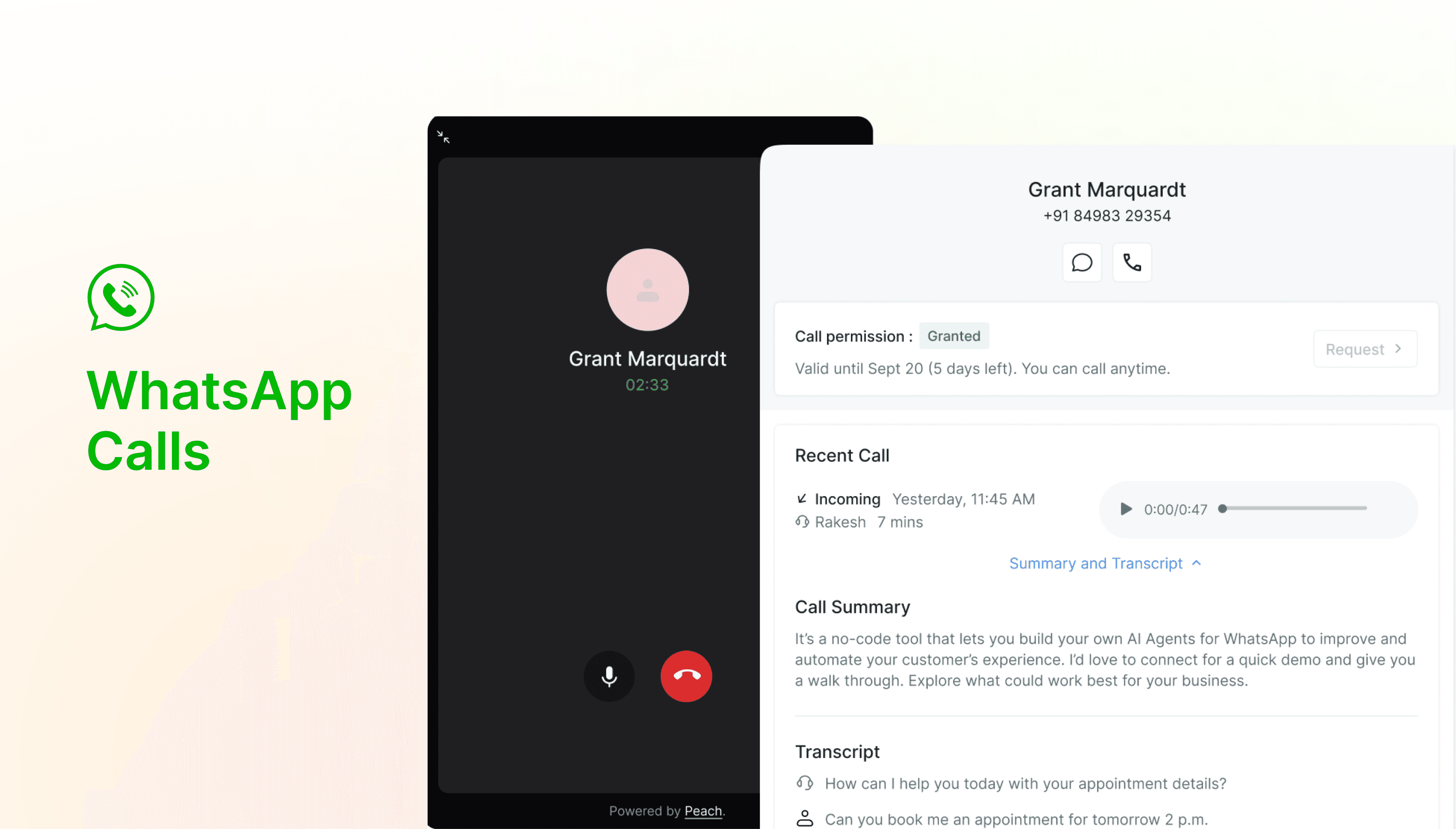
WhatsApp Business Calling puts the call in the same thread as the conversation. Not a separate app. Not a separate device. The same thread, with the same history, visible to the same manager, logged to the same CRM record.
When the call ends, the conversation continues. The follow-up message goes out in the same thread. The next agent who touches this account — whether it’s tomorrow or in three weeks — opens the conversation and sees everything: the qualification, the call duration, the outcome, the follow-up commitment.
No cold starts. No repeated introductions. No “I’ll have to check with my team and get back to you” because the team’s records are on three different devices.
The challenge with WhatsApp calling is not the feature. WATI offers WhatsApp calling. So do others. The challenge is what happens around the call — the qualification before it, the logging after it, and the routing that determines who takes it.
Every inbound lead on Peach goes through AI qualification first. The AI collects budget, intent, timeline, and the specific product they’re interested in — before any human picks up. By the time a call is routed to an agent, the agent already knows who they’re talking to, what they want, and how likely they are to close.
Your reps stop cold-calling qualified leads. They start calling prepared.
2. The customer has to start over
The agent makes or receives the WhatsApp call directly inside Peach. The entire conversation history is visible in the same interface. If the customer mentioned three months ago that they’d tried a competitor, that is right there. The agent does not have to ask again.
Call duration, start time, and outcome are recorded automatically.
This is the part that most platforms miss. Peach requires agents to complete a Disposition Field before they can close any conversation. Deal stage. Call outcome. Next action. Follow-up date.
Not optional. Not a suggestion. Required.
The result: 100% CRM data completeness within 30 days of going live. Every conversation has a logged outcome. Every lead has a next action. Every manager has a dashboard that reflects what is actually happening in the pipeline — not what agents remembered to type in.
A Promise to Pay is a verbal commitment. When it happens on a personal phone call, it is also an unverifiable one. When it happens inside Peach, it is timestamped, attributed to the agent, attached to the WhatsApp thread, and available to your compliance team in two clicks.
RBI audit requests stop being emergencies. They become filters.
3. Your ad spend becomes invisible
A customer considering a ₹60,000 purchase needs to feel like the company knows who they are. When the agent who calls them has the full conversation history — the browsing question they asked last week, the price objection they raised in chat, the specific model they were comparing — the call feels personal. It closes faster. And when it doesn’t close, the next agent picks up exactly where they left off.
City and dealer routing means every Click-to-WhatsApp lead reaches the right showroom automatically. The site visit call happens inside Peach. The customer gets one consistent experience. The manager sees the call log from the field agent who did the site visit, the follow-up from the relationship manager who handled the paperwork, and the closure note from whoever handled the final sign-off — all in one place.
The most common question we get from sales teams considering a move: will we lose our number?
No. If you are currently on WATI, AiSensy, or Interakt, your WhatsApp Business number migrates to Peach. Your customers keep reaching the same number. Your Meta Ads campaigns keep running unchanged. Peach adds attribution tagging on top — your existing CTWA campaigns are unaffected.
Per agent, the change takes under five minutes. They go from messaging on a personal device to messaging and calling from the Peach shared inbox on their laptop or mobile. Nothing else changes for the customer.
The first full week of structured data takes about seven days to establish. By Day 30, you have a baseline: first response time, call duration by agent, conversion rate by campaign source, and AI qualification rate. Numbers your pipeline has never had before.
Average call duration by agent. You will immediately find the outliers — the ones who are ending calls in two minutes because the lead isn’t ready, and the ones spending 45 minutes on conversations that should have been resolved in ten.
What changes when the call happens inside WhatsApp
First call contact rate for AI-qualified vs unqualified leads. The gap between these two numbers tells you exactly how much time your reps are currently wasting on leads that were never going to convert.
Call-to-close ratio by campaign source. For the first time, you will be able to map WhatsApp calls back to the ad creative that brought the lead in.
CRM data completeness. Before Peach, this number is typically below 40% for teams running on personal WhatsApp. After the Disposition Field is live, it reaches 95–100% within 30 days. That number alone changes how RevOps runs pipeline reviews.
If your qualification process is broken — if agents are calling unqualified, low-intent leads — moving those calls inside WhatsApp just makes the waste more visible. Faster rejection is still rejection.
The full value of WhatsApp calling appears when AI qualification runs first. The AI handles the top of funnel. Humans handle the conversations that are actually worth having. The call becomes the closer, not the first contact.
That is the inside sales motion Peach is built for: AI qualifies, human closes, everything is logged, nothing falls through the gap between apps.
Forty minutes a day per rep switching between apps is the number you can see. The number you cannot see is harder to calculate: how many leads went cold because the follow-up call happened from a number the customer didn’t recognise. How many deals died because the second agent had no context. How many campaigns were paused because attribution data made them look unprofitable when they weren’t.
How Peach makes WhatsApp calling operational for inside sales teams
WhatsApp calling inside Peach closes all three gaps at once. Not as a feature. As a structural fix for the way Indian inside sales teams actually work.
The Peach Team
Expertise in WhatsApp Sales & AI