The Era of the AI Employee: Scaling B2C Customer and Sales Support on WhatsApp
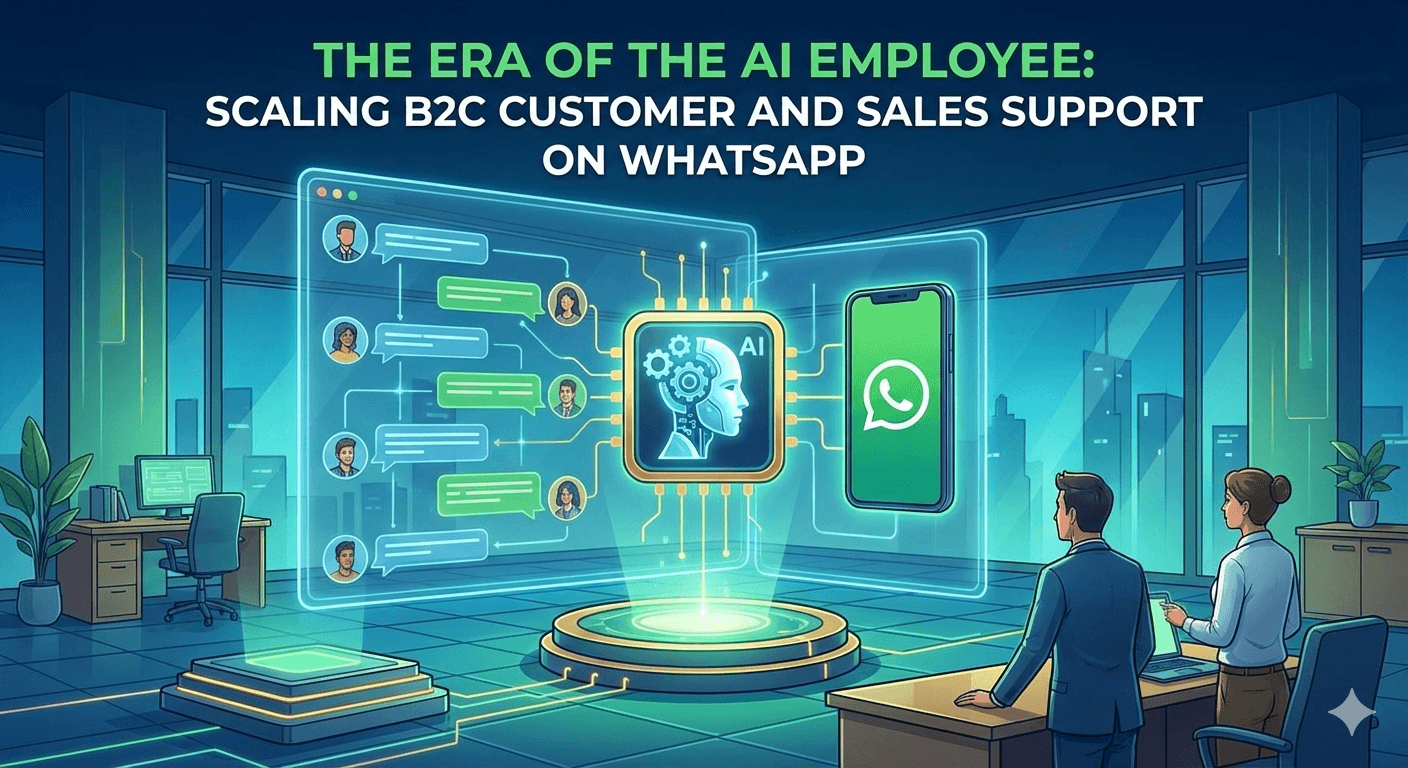
If you are a B2C founder or a Head of Growth, you have likely noticed a massive shift in how customers want to talk to you. The era of mobile-first is being rapidly overtaken by the era of AI-first. With over 3 billion monthly active users, WhatsApp has evolved from a simple messaging app into the primary infrastructure for conversational commerce and customer support.
Chatbots vs. AI Agents: Why the Distinction Matters for Founders
For years, the standard playbook was simple: hire more support agents as you scale, or deploy a rigid chatbot to deflect tickets. But in 2025, neither option is sustainable. Scaling human teams is expensive and hard to manage, while traditional rule-based chatbots—those frustrating menus that force users to type 1 for Sales or 2 for Support—often lead to dead ends and angry customers.
Enter the AI Agent. Unlike their chatbot predecessors, modern AI agents on WhatsApp don’t just deflect conversations; they resolve them. Powered by Large Language Models (LLMs) and deep integrations with your business systems, these agents can handle complex reasoning, process transactions, and act as a tireless extension of your team. Whether you are running a Fintech lending platform, an EdTech startup, or a high-volume D2C brand, the goal is no longer just answering tickets—it is about deploying an autonomous AI employee that drives growth and engagement 24/7.
Before you invest in a platform, it is critical to understand that not all automation is created equal. The market is flooded with tools promising AI, but there is a sharp operational difference between a standard chatbot and a true AI agent.
Traditional chatbots operate on decision trees. They look for specific keywords and deliver pre-scripted answers. They are excellent for static FAQs but fail miserably at ambiguity. If a customer asks a question that doesn’t fit the script, the bot breaks, often trapping the user in a loop.
AI agents represent a technological leap. They use Natural Language Understanding (NLU) to interpret intent, regardless of how a customer phrases a question. More importantly, they possess reasoning capabilities, allowing them to plan multi-step workflows to solve a problem,.
For example, if a customer asks, Where is my order? a chatbot might just link to a tracking page. An AI agent, however, can integrate with your logistics provider, see that the package is delayed, apologize, offer a discount code for the trouble, and update the CRM—all without human intervention.
One of the biggest friction points for founders is the setup time. Old chatbots required weeks of manually writing scripts. Modern AI agents—like Peach AI —solve the cold start problem by ingesting your historical support queries, help center articles, and PDFs. They learn your brand voice and policy nuances immediately, allowing you to launch in minutes rather than months.
AI agents are not a one-size-fits-all solution. The value they deliver varies significantly depending on your vertical. Here is how top B2C sectors are leveraging AI agents for customer service on WhatsApp to drive engagement.
Trust and security are the currency of Fintech. Customers expect instant answers regarding their money, but they also demand strict data privacy.
Security & KYC: AI agents can guide users through Know Your Customer (KYC) processes directly on WhatsApp, collecting documents and verifying identity within a compliant framework (SOC2/GDPR).
Claims & Applications: Instead of forcing users to download an app, an agent can process insurance claims or loan eligibility checks via chat. For instance, platforms like Convozen enable banking enterprises to automate complex workflows while maintaining context across conversations.
Instant Query Resolution: Agents can handle sensitive account inquiries, policy renewals, and fraud alerts instantly, reducing the load on Tier-1 support staff.
For EdTech, the challenge is often managing high-volume inquiries during enrollment seasons across diverse demographics.
Admissions & Counseling: Agents can automate student FAQs regarding course details, deadlines, and fee structures. By integrating with CRMs, they can qualify leads based on student intent before handing them off to a counselor.
Multilingual Support: Breaking language barriers is crucial. The UNESCO World Heritage bot is a prime example, using AI to provide educational content in 19+ languages, making learning accessible to a global audience.
In D2C, support is sales. The goal is to move from reactive ticket solving to proactive conversational commerce.
Consultative Sales: AI agents act as shopping concierges. Instead of just searching for keywords, they understand needs. If a user says, I need a laptop for video editing under £1000, the agent can filter the catalog and recommend the best options,.
High-Impact Use Cases by B2C Sector
Cart Recovery: Abandoned carts are a massive revenue leak. AI agents can send hyper-personalized nudges—offering a specific incentive or answering a hesitation-inducing question—which has been shown to increase conversion rates significantly,.
When evaluating, look for these three non-negotiable features that differentiate growth engines from simple support bots.
In many B2C markets, especially India and Latin America, users prefer sending voice notes or images over typing. Advanced agents now support multimodal interaction, meaning they can transcribe and reason through voice notes or analyze an image (e.g., a photo of a damaged product for a return) to process a claim automatically.
An agent is only as good as its connections. To truly resolve issues, it must sync with your tech stack—Shopify, Salesforce, HubSpot, or proprietary databases. If an agent cannot look up an order status in real-time or process a refund in your payment gateway, it is just a conversationalist, not a worker.
While the goal is automation, the Human-in-the-Loop model remains vital. The best systems use AI to handle 80% of the volume but intelligently detect frustration or high-value sales opportunities to escalate the chat to a human agent. Crucially, the human agent should receive a full summary of the conversation so the customer never has to repeat themselves
While the goal is automation, high-ticket B2C sales often require a human touch to close the deal. A specialized Shared Inbox acts as the safety net for your AI, bridging the gap between automation and human empathy. It eliminates the “fragmentation tax”—the time lost switching between your CRM, phone dialler, and WhatsApp.
For B2C growth teams, a standard inbox isn’t enough. You need these three capabilities:
Most shared inboxes only handle text. If a sales rep needs to call a lead, they usually have to pick up a physical phone or open a third-party app like Zoom or Aircall. This breaks the data flow.
With Context Calling, agents can click a phone icon inside the WhatsApp chat window on their desktop.
The call rings from your Verified WhatsApp Business Number (increasing pickup rates), and the call recording and transcript are automatically saved in the chat thread history. No lost context, no manual logging.
When you have multiple agents working on high-volume leads, you risk double-replies or missed context. A suite of collaboration tools is a must have to prevent this:
Collision Detection: Each chat should be assigned to only one agent preventing unprofessional double-responses.
Private Notes: Agents can tag managers or colleagues (e.g., “@Manager, can I approve a 15% discount?”) within the chat thread. These notes are invisible to the customer but permanent in the history.
Smart Tagging: Automatically tag conversations based on urgency or intent (e.g., “VIP,” “Pending Payment”, “Issue”) to filter views instantly.
You cannot improve what you cannot measure. A tool such as Peach AI transforms WhatsApp from a black box into a measurable revenue channel with granular reporting:
Agent Productivity Reporting: Track critical metrics like First Outbound Response (speed-to-lead) and Contacted vs. Pending ratios to see exactly which agents are working their pipeline and who is overloaded.
Chat Visibility Rules (Granular Permissioning): Not every agent needs to see every chat. Peach allows you to set strict visibility rules—Sales Reps only see their assigned leads, while Managers have a global view. This protects sensitive customer data.
Critical Features for B2C Growth Engines
Audit Reporting: For industries like Fintech and Healthcare, compliance is non-negotiable. Peach provides full Audit Logs that track every message sent, edited, or deleted, ensuring you have a permanent record of who said what and when.
With dozens of providers on the market, choosing the right AI agent for WhatsApp depends on your primary business objective. Below is a comparative analysis of the top contenders for 2025.
Platform
Best For
Key Feature
Support Resolution & Sales
Zero Markup / SaaS
Native Shared Inbox & RAG
Intercom (Fin)
SaaS & Fintech Support
Per-Resolution ($0.99)
Helpdesk Integration
Zendesk AI
Enterprise Governance
SaaS Subscription
Intent Routing
Wati
Top WhatsApp AI Agents for 2026
SMBs & Teams
Team Collaboration
If your primary pain point is burying your team under a mountain of support tickets, you need an agent focused on resolution accuracy and helpdesk integration.
- Peach AI Peach represents the next evolution of support with its Agent Crew architecture. Instead of a generic bot, Peach deploys a specialized Support agent on WhatsApp
Why it works: Best for WhatsApp. The Support AI Agent uses RAG (Retrieval-Augmented Generation) to answer questions strictly based on your uploaded PDFs, policies, and website data, ensuring zero hallucinations. Unlike rigid flows, it uses Reasoning Loops to solve problems and supports a smart Human-in-the-Loop workflow, instantly handing off complex or angry customers to a human agent via a Shared Inbox with full context.
Key Feature: Shared Inbox for Support teams on WhatsApp built for Enterprises. Zero Markup Pricing on Meta. Unlike competitors that add a 10–20% markup on Meta’s conversation fees, Peach offers direct-to-Meta billing, significantly reducing costs for high-volume support teams.
- Intercom (Fin) Intercom has successfully pivoted to an AI-first platform with Fin.
Why it works: Best for Web. Fin is a resolution bot that uses sophisticated LLMs to answer questions based strictly on your support content, minimizing hallucinations. It integrates natively with the Intercom helpdesk, making it a seamless addition for current users.
Key Feature: It charges per resolution ($0.99), aligning costs with success rather than just chat volume.
Best For: SaaS and Fintech companies that prioritize accurate, safe answers over marketing fluff.
- Zendesk AI A powerhouse for enterprise support, Zendesk’s AI agents are designed to handle complex service workflows.
Why it works: It offers autonomous agents that can be pre-trained on billions of real service interactions. It excels at intent detection, routing tickets to the right department if the AI cannot solve them
Key Feature: Deep integration with enterprise ticketing systems and robust security compliance.
Best For: Large scale B2C operations needing robust governance.
- Engaige For E-commerce brands tired of bots that just ‘deflect’, Engaige offers true resolution capabilities.
Why it works: It plugs directly into shipping and order management systems (OMS). It doesn’t just tell a customer their order is late; it can trigger a refund or update shipping details autonomously.
Key Feature: Traceable reasoning allows support managers to see exactly why the AI made a specific decision, ensuring transparency.
Implementation Strategy: Buying vs. Building
Best For: High-volume D2C brands on Shopify.
For founders focused on revenue, lead qualification, and broadcasting, these tools turn WhatsApp into a sales channel.
- Peach AI: We are biased towards Peach AI because it fundamentally shifts the technology from Flow Builders (static decision trees) to Agentic AI (Reasoning Loops). While other tools just broadcast notifications, Peach deploys specialized Agent Crews—like the Sales Hunter or Triage Agent—that actively negotiate and close deals.
Why it works: It enables Agentic Commerce, allowing the AI to autonomously negotiate price objections for high-ticket abandoned carts (increasing recovery rates from 2% to 17%) and qualify leads before booking meetings.
Key Feature: Agent Builder with RAG capability. The platform operates on a Zero Markup model (Direct-to-Meta billing), meaning you don’t pay the 10-20% extra message fees charged by competitors like Wati or AiSensy, making high-volume broadcasting significantly cheaper.
Best For: Growth teams and founders who want to automate MQL to SQL lead qualification, Cart abandonment improvement and Onboarding Funnel drop-offs and not just send alerts.
- AiSensy AiSensy focuses on leveraging the official WhatsApp Business API for campaigns.
Why it works: It excels at broadcasting and Click-to-WhatsApp ads. While it offers chatbot capabilities, its strength lies in marketing automation and lead generation.
Key Feature: Smart campaign management that filters leads before they reach sales teams.
Best For: Marketing teams driving traffic and leads via WhatsApp.
- Zoko / Interakt These platforms are built specifically for the Shopify/WooCommerce ecosystem.
Why it works: They treat WhatsApp as a storefront..It focuses on maximizing CLV (Customer Lifetime Value) through automated cart recovery and upsell flows.
Key Feature: Native catalog integration allows customers to browse and buy without leaving WhatsApp.
Best For: D2C founders looking to monetize their WhatsApp audience.
Not every startup needs enterprise-grade complexity. These tools offer speed and affordability.
- Wati Wati (WhatsApp Team Inbox) is a robust, no-code solution for teams needing to organize their communication.
Why it works: It combines a shared team inbox with a visual chatbot builder. It’s accessible for non-technical teams and offers KnowBot functionality to train a basic AI on your documents,.
Future Trends: What B2C Founders Must Watch
Key Feature: Simplicity and team collaboration features at a reasonable monthly price point.
Best For: SMBs and agencies needing a quick, reliable WhatsApp setup.
- BotPenguin
Why it works: It offers a generous free tier and an easy drag-and-drop builder, making it highly attractive for early-stage startups testing the waters.
Key Feature: ChatGPT integration allows for natural conversations even on lower-tier plans.
Best For: Bootstrapped startups and small local businesses.
- Botpress For Fintechs or tech-heavy EdTech companies that need deep customization and control over their data.
Why it works: It is an open-source platform that allows developers to build highly complex, bespoke conversational flows. You are not limited by a drag-and-drop interface; you can inject custom code and logic.
Key Feature: Vision AI and extensive API connectors allow for building agents that can see and do almost anything.
Best For: CTOs and product teams who want to build a proprietary support experience.
Once you have identified the right tool, the next decision for a founder is the commercial model. This choice impacts your long-term margins and data sovereignty.
Most platforms listed above (Intercom, Wati, Zendesk) operate on a SaaS model. You pay a monthly subscription plus usage fees.
Pros: Fast deployment, managed infrastructure, continuous updates.
Cons: Recurring costs can scale linearly with your user base. You are renting the capability.
An emerging model, championed by platforms like Fuzen, challenges the SaaS status quo.
The Concept: You pay a one-time fee to acquire the chatbot code and infrastructure setup. You own the system forever and only pay for the underlying API usage (e.g., OpenAI or Twilio costs).
Why it matters: For Fintechs concerned about data privacy or D2C brands worried about SaaS bloat, owning the AI employee can result in 10-100x cost savings over time compared to monthly subscriptions.
Conclusion
Regardless of the build model, all WhatsApp AI agents must navigate Meta’s 24-Hour Rule. Businesses can respond freely to user messages within a 24-hour window. Once that window closes, you must use a pre-approved (and paid) Message Template to re-engage the customer. Successful implementation requires an agent that is programmed to maximize engagement within that active window to keep costs low.
As we move through 2025 and into 2026, the capabilities of AI agents for customer service on WhatsApp are accelerating. For founders, staying ahead means looking beyond simple text automation. The market is shifting from reactive chatbots to proactive, multimodal intelligence. Here are the three critical trends that will define the next generation of B2C growth.
The metric for success is changing. Previously, a bot succeeded if it deflected a ticket away from a human. Today, the goal is autonomous resolution. We are seeing a shift toward Agentic AI—systems that can reason, plan, and execute multi-step workflows without human input.
Instead of just answering Where is my order?, an agentic system on WhatsApp can now access your logistics provider’s API, identify a delay, process a goodwill refund within your set limits, and update the CRM—all in one flow. This moves the AI from a digital receptionist to a digital worker capable of handling complex logic like claims processing or loan origination.
If you operate in markets like India, Latin America, or parts of Europe, you know that users love sending voice notes. Until recently, this was a dead-end for automation. Now, advanced agents are incorporating multimodal capabilities, allowing them to transcribe and reason through voice notes instantly.
Furthermore, Vision AI is becoming standard for support. Imagine a customer reporting a damaged product. Instead of describing it, they simply snap a photo on WhatsApp. The AI agent analyzes the image, confirms the damage against warranty policies, and approves the return label automatically. This reduces friction significantly and prevents the back-and-forth usually required for evidence collection.
The days of generic blast broadcasts are ending. The future lies in hyper-personalization where the AI agent anticipates needs based on context.
By integrating deeply with browsing history and purchase data, agents are evolving into proactive consultants. If a customer was looking at a specific insurance policy or a pair of sneakers but didn’t buy, the AI can send a specific, helpful nudge on WhatsApp—not just a discount, but an answer to a potential hesitation (e.g., Hi, I noticed you were looking at the Premium Plan. Did you know it covers dental too?),. This moves WhatsApp from a support channel to a primary revenue driver, with some brands seeing up to a 2.5x increase in conversion rates through these personalized interventions.
The shift to AI agents for customer service on WhatsApp is not just about cutting costs—it is about meeting your customers where they are, with the speed and intelligence they expect. Whether you are a D2C founder looking to recover abandoned carts or a Fintech leader needing secure, 24/7 KYC support, the tools available in 2025 offer a level of autonomy and ease we haven’t seen before.
Ready to scale? Start by auditing your current ticket volume. Identify the top 20% of repetitive questions that take up 80% of your team’s time, and pilot an AI agent to handle just those. You will likely see the ROI in weeks, not months
Launch your first Customer Support Agent in 15 minutes [Free]
Build a WhatsApp Agent in 5 Minutes
How D2C brands are using proactive nudges
Ultimate Guide to WhatsApp Shared Inbox for Sales and Customer Support Teams
The Peach Team
Expertise in WhatsApp Sales & AI